Books, videos, and music - all free from your public library!
LoginSign Up

Footer

Hoopla logo, Go to homepage
  • For Patrons
  • For Libraries (opens in new window)
  • For Vendors (opens in new window)
  • Facebook (opens in new window)
  • X (opens in new window)
  • Instagram (opens in new window)
  • YouTube (opens in new window)
  • TikTok (opens in new window)
  • LinkedIn (opens in new window)

Our Company

  • Our Story
  • Get Hoopla for your Library (opens in new window)
  • Get your content on hoopla (opens in new window)
  • Join our team (opens in new window)
  • Accessibility Statement

Our Content

  • Audiobooks
  • Ebooks
  • Movies
  • Television
  • Comics
  • BingePasses
  • Music
  • The Loop Blog

Help

  • Help Center
  • Submit Feedback
  • Facebook (opens in new window)
  • X (opens in new window)
  • Instagram (opens in new window)
  • YouTube (opens in new window)
  • TikTok (opens in new window)
  • LinkedIn (opens in new window)
  • Download on the App Store (opens in new window)
  • Get it on Google Play (opens in new window)
  • Available at Amazon Appstore (opens in new window)
© 2026 Midwest Tape, LLC. All rights reserved. Privacy Policy | Terms of Use
  • Hoopla logo
  • Browse
  • My Hoopla
  • Log In
  1. Navigate Home
  2. Ebooks
  3. Two Kingdoms & Two Cities

EBOOK

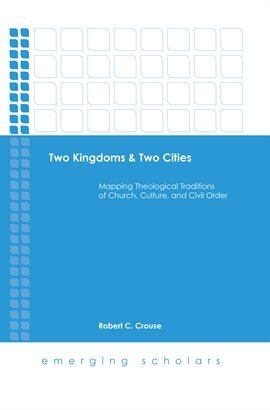
Two Kingdoms & Two Cities

Mapping Theological Traditions of Church, Culture, and Civil Order

Robert C. CrouseSeries: Emerging Scholars
(0)
sign up
Pages
274
Year
2017
Language
English
Publisher
Augsburg Fortress Publishers

About

The recent emergence of "two kingdoms" and "two cities" approaches to Christian social thinking are shown to have a key-and often unacknowledged-connection to Luther's reshaping of the Augustinian paradigm. The project works for a better understanding of Luther's own thought to help understand the convergences and divergences of Christian political theology in the twentieth century and today.
In particular, Luther's two-kingdom thinking issued forth in a strong distinction of law and gospel that was also worked out in twofold pairs of Israel and church, general and special revelation, creation and redemption, and especially the outward and inward life. The work traces this legacy through acceptance and modification by Niebuhr and Bonhoeffer, Lutheran and Catholic neoconservatives, Reformed two-kingdom proponents, Augustinian liberals, and finally Oliver O'Donovan. The conclusion reflects on both the historical narrative and its connection to an account of modern liberalism, as well as a theological reflection on hermeneutical decisions of the "twoness" of Christian theology.
Related Subjects

  • Eschatology
  • Religion
  • Adult Nonfiction
  • Systematic
  • Christian Theology
  • General
  • Christian

Extended Details

  • SeriesEmerging Scholars

    Artists

    Robert C. CrouseAuthor