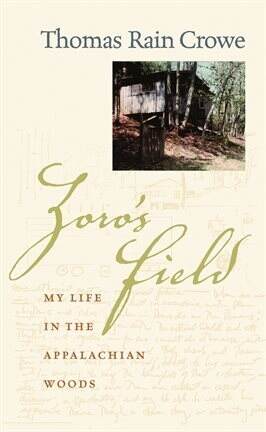
After a long absence from his native southern Appalachians, Thomas Rain Crowe returned to live alone deep in the North Carolina woods. This is Crowe's chronicle of that time when, for four years, he survived by his own hand without electricity, plumbing, modern-day transportation, or regular income. It is a Walden for today, paced to nature's rhythms and cycles and filled with a wisdom one gains only through the pursuit of a consciously simple, spiritual, environmentally responsible life.
Crowe made his home in a small cabin he had helped to build years before-at a restless age when he could not have imagined that the place would one day call him back. The cabin sat on what was once the farm of an old mountain man named Zoro Guice. As we absorb Crowe's sharp observations on southern Appalachian natural history, we also come to know Zoro and the other singular folk who showed Crowe the mountain ways that would see him through those four years.
Crowe writes of many things: digging a root cellar, being a good listener, gathering wood, living in the moment, tending a mountain garden. He explores profound questions on wilderness, self-sufficiency, urban growth, and ecological overload. Yet we are never burdened by their weight but rather enriched by his thoughtfulness and delighted by his storytelling.
"I have known Thomas Crowe for thirty years or so, as poet, writer, editor, and community activist. Before he returned to North Carolina he was a neighbor in my part of California. I have always respected his work and dedication as someone who has truly found both his place and his work, and recommend him highly. His writing speaks from a fluency with landscape and an ease with language like water
Gary Snyder, author of The Practice of the Wild
"Court jester, philosopher, provocateur, smarty pants: Michael Martone, is this allowed? You have a glorious and weird brain, and you don't seem to care who knows it. Brooding on your Brooding makes me glorious and weird too, makes me glad that this world has all the books in the world, and just when we think we have what we need, you go and pull a stunt like this. Thank God."
Thomas Berry, author of The Dream of the Earth
"Crowe's writing arises from his close connection with the land, his poetry, and his devotion to uncovering the spirit of the place of his habitation. The result is that the work sings with the music of his own voice."